

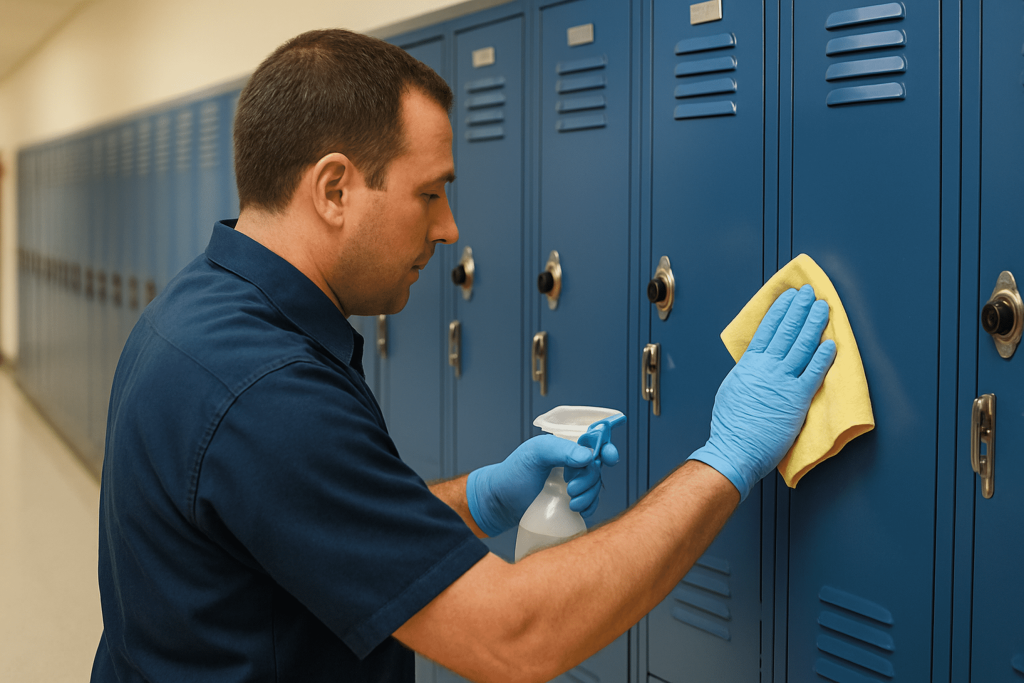
A safer school starts long before the first bell rings. It starts with people—trained cleaners following proven protocols—because school janitorial services are the quiet engine of daily safety. When teams understand the “why” behind each task, they protect health, prevent accidents, and keep learning on track.
Why School Janitorial Services Drive Safety
School cleaning needs aren’t met by a once-a-week deep clean; they require a disciplined routine. Accordingly, trained teams anticipate pathogen pathways, floor-care friction, and chemical handling. As a result, they disinfect high-touch points at the right cadence, maintain walkable, dry floors, and store chemicals correctly—so classrooms stay healthy and hallways remain hazard-free. And yes, when families and staff see consistent standards, trust rises daily.
Air Quality
First, HEPA vacuums, vent dusting, and timely filter checks reduce irritants. Consequently, fewer coughs and clearer focus follow.
Touch Points
Moreover, doorknobs, desks, railings, and keyboards—cleaned and disinfected on schedule—limit cross-contamination and absenteeism.
Slip Prevention
Likewise, the right product, dwell time, and signage lower slip risks during wet weather and after spills.
Daily Safeguards
- To begin with, targeted disinfection of high-touch surfaces between classes
- In addition, restroom checks for soap, towels, and timely sanitizing
- Next, entryway mat maintenance to trap grit and moisture
- Then, spot mopping and cone/sign placement to prevent slips
- Finally, waste removal before overflow invites pests or odors
Smart Training, Real Results
| Training Module | What It Teaches | Safety Outcome |
| Chemical Right-Sizing | Dilution, labeling, SDS basics | Fewer exposures, clearer audits |
| Floor Care & Friction | Pads, finishes, cure times | Reduced slips and falls |
| Infection Control | Dwell times, touch-map routing | Lower illness transmission |
| Emergency Cleanup | Containment, PPE, biohazards | Faster, safer incident response |
Green Choices
Therefore, gentler, effective products can protect people and surfaces without sacrificing results.
Smart Scheduling
Nightly routines, plus mid-day touch-ups in restrooms and cafeterias, balance learning time with cleanliness.
Clear Checklists
Indeed, room-by-room task lists eliminate gaps and ensure consistency when staff rotate.
Rapid Response
From a cafeteria spill to a lab mishap, trained teams contain first, clean second—so classes resume quickly.
How Training Decodes to Fewer Incidents
Well-trained cleaners see what others miss. For instance, they note a loose threshold before it trips a student; they remove a cord from a walkway before it becomes a hazard; they set cones before mopping, not after. Because school janitorial services run on standard operating procedures (SOPs), they produce predictable outcomes: cleaner air, drier floors, stocked restrooms, and safer stairs.
Furthermore, pros track leading indicators—soap refills, mat saturation, scuff accumulation—rather than waiting for complaints. As a result, risk gets addressed upstream, where it’s cheaper, faster, and far less disruptive.
SOPs That Keep Class in Session
- First, zone plans: classrooms, labs, cafeterias, and gyms—each mapped with frequencies, products, and methods.
- Second, touch-map routes: sequenced passes that start “clean to dirty,” ending in restrooms.
- Third, dwell discipline: applying disinfectants and letting them work, instead of “wipe and hope.”
- Fourth, mat strategy: triple-matting at entrances to cut slip risks and floor wear.
- Fifth, restroom rhythm: mid-day refreshes for supplies, odor control, and spot disinfection.
- Sixth, event turnovers: rapid setups and tear-downs for assemblies and sports—without shortcuts.
Outsourced vs. In-House: What Changes?
Even if you keep a small in-house crew, partnering with professionals elevates the baseline. With school janitorial services, you get trained floaters for absences, specialty floor work without renting equipment, and documented procedures that stand up to audits. Meanwhile, administrators can stay focused on teaching and student support—not mops, mixes, or maintenance backlogs.
Cost Controls That Don’t Cut Corners
You avoid waste because training reduces rework, and correcting dilution extends product life. When floors are maintained properly, they last longer between costly refinishing cycles.
Quick Implementation Plan
- Assess & Prioritize: walk the campus, then rank risks—restrooms, cafeterias, stairwells.
- Map Frequencies: set daily, weekly, monthly, and seasonal deep cleans.
- Standardize Kits: deploy color-coded cloths, labeled bottles, and posted SOPs.
- Train & Verify: deliver short, hands-on modules with check-offs and refreshers.
- Measure What Matters: track absentee trends, slip tickets, supply usage, and complaint logs.
- Iterate: review patterns and adjust routes and frequencies accordingly.
Compliance & Documentation Matter
Crucially, safety is measurable. Therefore, logs, checklists, and incident notes create a defensible record that shows what was cleaned, when, and how. Moreover, those records help leaders spot patterns—recurrent spill zones, recurring supply shortages, or seasonal hotspots—and then adjust staffing or routes. Consequently, inspections become faster, audits are simpler, and corrective actions are clearer.
Additionally, alignment with district policies keeps expectations consistent across campuses. Thus, substitutes can step in, follow the documentation, and deliver steady results without guesswork. In the same way, vendors can coordinate seamlessly with in-house staff because the playbook is visible.
Communication Loops That Work
Importantly, safety improves when communication flows both ways. Hence, principals flag schedule changes early, teachers report emerging concerns promptly, and custodians share on-the-ground insights continually. As a result, spills, shortages, and minor repairs are handled before they escalate. Even brief updates help consistently.
In addition, brief tailgate meetings at shift start keep priorities aligned. Notably, five focused minutes can clarify room closures, special events, or weather alerts—so the right people are in the right place at the right time.
Make Safety Daily
Ultimately, daily safety doesn’t happen by accident but by routine. With school janitorial services, trained people, and clear SOPs, you cut illness, slips, and surprises. For New York campuses ready to lock in that consistency, connect with Reliable Janitorial NY to customize a plan that fits your bell schedule, budget, and goals.
